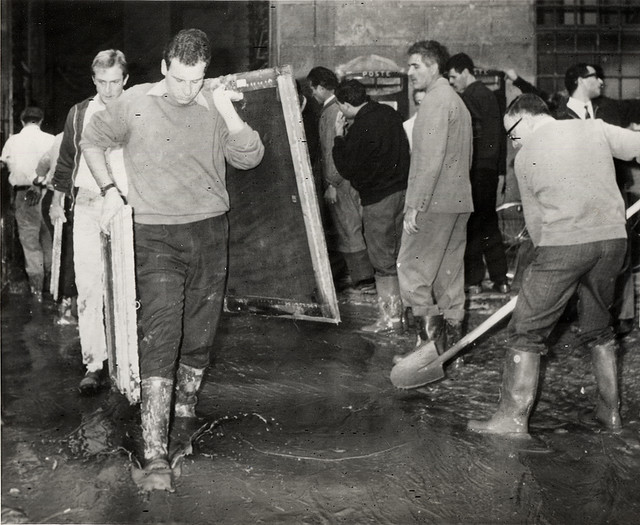
Florence, November 1966. Volunteers help bring paintings from the Uffizi to safety following the catastrophic flooding of the Arno River.
Source: Wikimedia Commons, “Volontari Firenze 1966.” Historical photograph, November 1966.
What the 1966 Flood Taught Us About Conservation, Collaboration, and Cultural Heritage
There are certain events in conservation that become more than history. They become part of the profession itself, passed from one generation of conservators to the next through teaching, experience, and memory.
For me, the flood of Florence in 1966 is one of those events.
I trained as a conservator in Florence many years after the flood, but its presence was still very much alive in the classroom.
Many of my professors had lived through those years and had witnessed the extraordinary conservation effort that followed.
I still remember them showing us black-and-white photographs of people standing in water and mud, carrying paintings that were completely soaked. Some of those images were difficult to comprehend. Artworks that had survived for centuries were suddenly saturated with water, covered in mud, unstable, and in immediate danger.
But what stayed with me even more than the photographs were the stories behind them.
Our professors spoke about the problems they had encountered: saturated paintings, unstable surfaces, changes in wooden supports, mold, and the difficult decisions that had to be made while the works were still wet.
They described situations for which established procedures were not always sufficient and where conservators had to observe, adapt, and exchange knowledge as the emergency unfolded.
And this is where something extraordinary happened.
Conservators, scientists, historians, technicians, museum professionals, students, and volunteers came together. Specialists arrived from different countries, bringing their own training, experience, and approaches to treatment.
Knowledge was shared.
Methods were discussed.
Solutions were adapted.
And the international conservation community learned from the experience together.
That sense of exchange was something my professors spoke about with great intensity.
There is an Italian word that comes to mind when I think about those years: tramandare.
It is difficult to translate perfectly. It means to pass something down from one generation to another, not simply information, but knowledge shaped by experience.
That is what our professors were doing with us.
They were not simply teaching techniques from a textbook. They were entrusting us with experience that had been acquired during an extraordinary and, in many cases, heartbreaking period.
I also remember my professors speaking about techniques and knowledge that arrived in Florence through conservators from other European countries.
One memory that has always stayed with me is their discussion of wax-resin lining. I remember being told that conservators from Holland shared their experience with this method.
Wax-resin lining has a long history in the Netherlands and became widely known as the “Dutch method.” Although I cannot independently verify today the exact circumstances in which that particular technique was introduced or taught in Florence after the flood, the memory itself reflects something very real about the period: conservation knowledge was moving across borders, and professionals were learning directly from one another.
For us as students, that was an important lesson.
Conservation knowledge does not belong to one person, one studio, or one country.
It grows through exchange.
What happened in Florence
On November 4, 1966, after days of heavy rain, the Arno River flooded Florence.
Water, mud, debris, and fuel oil entered the historic center, affecting churches, museums, libraries, archives, homes, and historic buildings.
The damage to cultural heritage was immense.
At the Uffizi and throughout Florence, artworks had to be moved and stabilized under extremely difficult conditions. Paintings, sculptures, frescoes, books, manuscripts, furniture, and decorative arts were all affected.
One of the most devastating examples was Cimabue’s great Crucifix in Santa Croce. The work was saturated by floodwater, mud, and fuel oil, and approximately sixty percent of its painted surface was lost.
At the same time, an extraordinary rescue effort began.
Thousands of volunteers came to Florence to help recover books, artworks, and cultural material. Many of these young volunteers became known as the Angeli del Fango—the Mud Angels.
Alongside them, conservators and specialists from Italy and abroad contributed technical expertise, equipment, research, and treatment experience.
The flood became a defining moment for modern conservation.
It reinforced the importance of documentation, collaboration, scientific research, emergency planning, preventive conservation, and the exchange of knowledge across institutions and countries.

Emergency conservation work on a flood-damaged painting following the 1966 Florence flood.
Source: Uffizi Galleries, Photographic Department, 1966 Flood Archive.
The value of working together
Another lesson from Florence that has never left me is the importance of collaboration.
Conservation is sometimes imagined as one person working quietly at a table with one artwork.
Of course, much of our work can look like that.
But complex conservation problems often require many areas of expertise.
A conservator may need to work with scientists, art historians, framers, art handlers, engineers, collection managers, insurance professionals, building managers, or specialists in other conservation disciplines.
No one person has every answer.
Florence made that very clear.
The international response brought together people with different backgrounds and different forms of expertise.
They shared what they knew and learned from one another.
That spirit still feels very modern to me.
Today we have analytical tools, imaging systems, scientific testing, new materials, and technologies that my professors could never have imagined.
But collaboration remains one of the most valuable resources in conservation.

Flood-damaged manuscripts from the National Library of Florence being washed as part of the emergency conservation response following the 1966 Arno flood.
Source: UNESCO / Dominique Roger. UNESCO Archives. CC BY-SA 3.0 IGO.
Conservation begins before treatment
One of the strongest lessons from Florence is that conservation does not begin after damage occurs.
It begins before.
It begins with understanding the environment in which an artwork lives.
It means paying attention to roofs, windows, plumbing, drainage, climate-control systems, humidity, storage, framing, and documentation.
It means understanding where vulnerabilities exist.
And it means having a plan before an emergency happens.
This is something I think about often in our work today, especially here in Florida.
Our circumstances are different from Florence in 1966, but hurricanes, heavy rain, roof failures, plumbing leaks, flooding, high humidity, and mold are very real concerns for collections in our region.
When water reaches an artwork, the visible damage is only part of the problem.
Canvas, wood, paper, adhesives, grounds, paint layers, gilding, and coatings can all respond differently to moisture.
What appears stable at first may change over the following hours or days.
And sometimes the instinctive response is not the safest one.
Drying an object too quickly, for example, can create additional stress in certain materials. After the Florence flood, some damaged panel paintings were placed in the Boboli Lemon House, where environmental conditions could be managed to help avoid overly rapid drying.
That example still illustrates something fundamental about conservation.
We do not simply react to damage.
We try to understand the materials, the condition, the risks, and what is likely to happen next.
Sometimes the correct decision is immediate treatment.
Sometimes it is controlled drying and monitoring.
Sometimes it is stabilization until a more complete treatment can begin.
And sometimes the most responsible decision is to do less.
That judgment is one of the most important things my professors were trying to teach us.
Sixty years later
When I look at photographs of the Florence flood today, I see them very differently than I did as a student.
At that time, I was trying to understand what had happened and what my professors were teaching us.
Today, after many years of conservation practice myself, I understand more clearly what they were passing on to us.
It was not only technical knowledge.
It was judgment.
It was responsibility.
It was respect for the artwork and for the history it carries.
And it was the understanding that experience becomes truly valuable when it is shared.
The Florence flood was a tragedy, but the response also demonstrated the extraordinary strength of an international community working together to protect cultural heritage.
People from different countries, professions, and backgrounds came together because they understood that these works were worth preserving.
That lesson remains just as meaningful today.
Every generation of conservators receives knowledge from those who came before us.
We add to it through research, science, technology, and our own experience.
And then, hopefully, we pass it forward.
That, to me, is one of the most important legacies of Florence.
Barbara Stella
Chief Conservator & Founder
Stella Art Conservation
Sources & Further Reading
The Uffizi Galleries — “The 1966 Flood’s Damages to the Art Heritage of Florence”
The Uffizi Photographic Department’s account of the November 1966 flood, the emergency rescue of artworks, the damage to Cimabue’s Crucifix, international volunteer response, and the stabilization and treatment of flood-damaged works.
ICCROM — ICCROM and the Conservation of Cultural Heritage: A History of the Organization’s First 50 Years, 1959–2009
Documents ICCROM’s role, together with UNESCO, in coordinating international safeguarding efforts following the Florence and Venice floods, including technical advice, planning, information exchange, and international assistance.
ICCROM — “The National Library of Florence: Difficult Decisions Following the 1966 Flood”
A detailed conservation account of the unprecedented challenges faced at the Biblioteca Nazionale Centrale di Firenze, including the arrival of international specialists, experimental decision-making, training, and knowledge exchange during the recovery.
Library of Congress — “A Brief History of Preservation and Conservation at the Library of Congress”
Discusses the international significance of the Florence flood and describes it as an event that fundamentally shaped book conservation and the emergency management of cultural heritage.
UNESCO World Heritage Centre — International Safeguarding Campaign following the 1966 floods
Documents UNESCO’s international appeal for solidarity following the catastrophic November 1966 flooding in Florence and Venice and the broader international response to damaged cultural heritage.
University of Amsterdam — “Conserving Wax-Resin Lined Paintings” / Amsterdam Wax-Resin Project
Documents the history of wax-resin lining in the Netherlands, its development by Nicolaas Hopman and Willem Anthonij Hopman, and its widespread identification as the “Dutch method.”
Rijksmuseum — “Wax-Resin Lining”
Provides additional conservation research and historical context for wax-resin lining, also identifying the technique as the “Dutch method.”
The personal recollections in this article—including memories of my professors, classroom discussions, photographs shown during my training, and their accounts of conservation practice following the flood—reflect my own experience as a conservation student in Florence.